




CBD and THCA Together: What Happens and How to Use Them

Quick answer: You can use CBD and THCA flower together by mixing them in a bowl, joint or vaporizer. Heat turns THCA into intoxicating THC and CBDa into non-intoxicating CBD. Many people use a mix to make THCA flower feel lighter, though research on how the two interact is limited. Start with mostly CBD and adjust slowly.
CBD and THCA work as a pair mainly because of heat. THCA is the raw, acidic form of THC. When you smoke or vaporize THCA flower, it converts into THC, so a CBD-and-THCA session behaves like a CBD-and-THC session. Raw, unheated THCA does not intoxicate. Which of the two you get depends on how you use the product, and the label tells you what is inside it. This guide covers the chemistry, the ratio evidence, the label math, the safety facts and how to pick a product. It is written for adults 21 and older who buy hemp flower, pre-rolls, vapes and concentrates, and for resellers who stock them.
TL;DR
- THCA is not psychoactive in its natural state, but smoking or vaping converts it to THC, which can make you feel high (CDC).
- CBD does not cause a high. Its effect on THC depends on dose: in one trial, low-dose CBD increased intoxication and high-dose CBD reduced it (2019 randomized trial).
- Use total THC, not THCA percentage alone, to judge strength. The CDC notes that THCA flower often reaches 15% to 20% total THC when smoked or vaped.
- Either compound can contribute to a positive urine drug test.
Table of Contents
- What CBD and THCA are
- Raw versus heated: two different experiences
- What research says about CBD with THC
- Reading the label: total THC, not just THCA
- Safety: what to know before combining them
- Drug testing
- How to choose CBD and THCA products
- Our perspective
- Where to start
- FAQ
- Sources
What CBD and THCA are
The cannabis plant contains at least 125 different cannabinoids, according to the National Institute on Drug Abuse. Two of them matter here.
CBD (cannabidiol) does not cause a high.
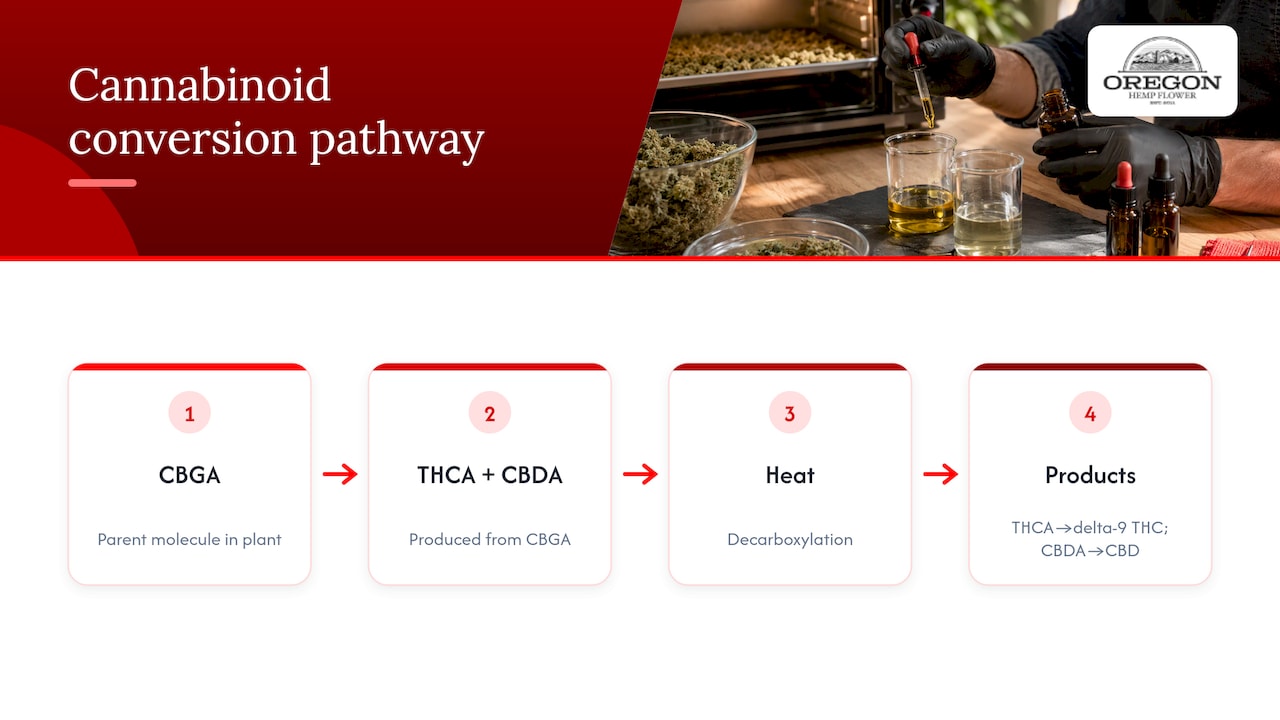
THCA (tetrahydrocannabinolic acid) is the acidic precursor of THC. In the living plant, a parent molecule called CBGA is converted into THCA and CBDA, the inactive acidic forms of THC and CBD. Under high temperatures, a process called decarboxylation, THCA becomes delta-9 THC and CBDA becomes CBD. Hemp plants produce more THCA than THC, which is why THCA is the main cannabinoid in most hemp flower.
That is the whole reason “CBD and THCA together” is not a simple pairing. Before heat, you have two non-intoxicating compounds. After heat, you have CBD and THC.
For a deeper look at the conversion, see our guide on how heat turns THCA into THC.
Raw versus heated: two different experiences
The method you choose decides what the combination does.
| Method | What happens to THCA | What to expect |
|---|---|---|
| Raw (tinctures, topicals, unheated plant material) | Stays as THCA | The Legislative Analysis and Public Policy Association says raw THCA does not intoxicate |
| Smoking, vaping, dabbing | Converts to THC | The CDC says it can cause a high and mind-altering effects |
The same fact sheet notes that hemp-extracted THCa is federally legal under the 2018 Farm Bill. State rules differ, so check yours before ordering.
If you smoke a flower that is high in THCA and also contains CBD, you are inhaling both CBD and newly formed THC. The question is no longer “does THCA work with CBD?” but “what ratio of CBD to THC am I getting?”
What research says about CBD with THC
Most human data on combining the two compounds studies CBD with THC, because that is what THCA becomes when heated. A few findings are useful for anyone choosing a product.
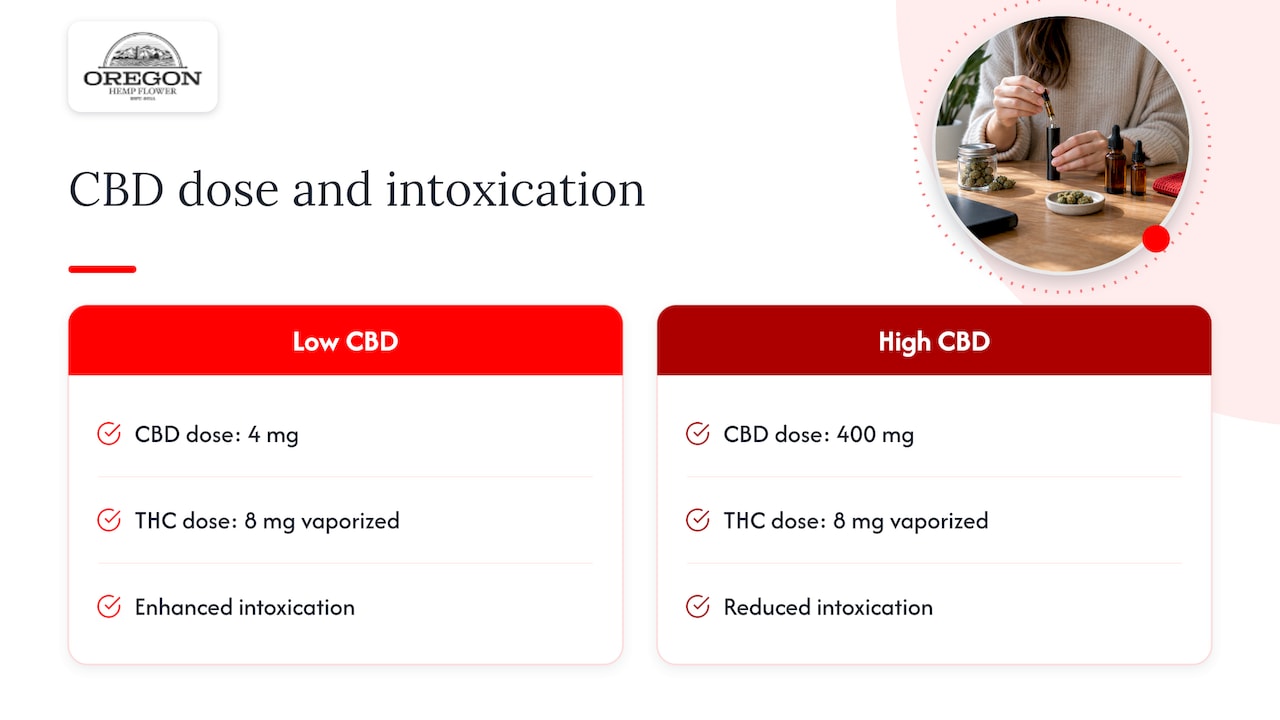
Dose matters. A 2019 randomized, placebo-controlled trial with 36 participants gave 8 mg of vaporized THC with different amounts of CBD. Low-dose CBD (4 mg) enhanced intoxication. High-dose CBD (400 mg) reduced it. The enhancement from low-dose CBD was strongest in people who use cannabis infrequently. The authors point to what this means for the THC:CBD proportions in plant material, whether used medicinally or recreationally.
The practical lesson for newer users is to start with a small amount, wait, and add only if needed. A flower with a small amount of CBD does not make a THCA flower gentler by default.
Metabolism overlaps. Both THC and CBD are largely processed by the liver. The review also notes that inhalation can worsen interactions.
The point is that ratios and amounts are what you control. The next section shows how to read them.
Reading the label: total THC, not just THCA
A THCA percentage on a jar is not the amount of THC you will get. Only part of the THCA converts when heated, and the standard way to estimate the result is total THC:
Total THC = (THCA × 0.877) + delta-9 THC
A flower labeled 30% THCA with a small amount of delta-9 THC works out to roughly 26% total THC. Our article 30% THCA to 26.31% total THC walks through the conversion using real lab numbers.
Why this matters: the CDC reports that many hemp businesses sell THCA flower without labeling total THC, and that these products often have a total THC of 15% to 20% when smoked or vaped. Consumers may then feel stronger effects than they expected.
The same logic applies to CBD content. A CBD flower lab report lists CBD, CBDA, and other cannabinoids separately. Our guide to reading the percentages on a CBD flower lab report shows how to find each figure.
A quick checklist before you buy any CBD or THCA product:
- Find the THCA, delta-9 THC and CBD percentages on the lab report.
- Calculate total THC with the formula above.
- Compare the CBD figure against the total THC to see your approximate ratio.
- Check that the batch on the report matches the batch you are buying.
- Decide your method (raw or heated) before you decide your amount.
Label accuracy is a general problem in the CBD market. SAMHSA cites a study of 84 commercial CBD extracts in which only 26 (31%) labeled the CBD concentration accurately, and 21.4% contained unlabeled delta-9 THC. That is the reason to buy from a source whose products are sorted by cannabinoid type and described in specific terms.
Safety: what to know before combining them
These are the facts that matter for safe use.
Age. Our products are for adults 21 and older. Keep all hemp products away from children and pets.
Injury is often detected only through blood tests.
SAMHSA lists adverse drug interactions and liver effects among potential CBD risks, and says CBD may produce psychotic effects or cognitive impairment in people who also regularly use delta-9 THC products. Strong CYP3A4 inhibitors can raise THC levels and inducers can lower them, according to the 2023 review.
Pregnancy and reproduction. The FDA says animal studies identified male reproductive toxicity.
Do not drive or operate machinery afterward.
Check your state’s rules on hemp-derived products before you order.
For how THCA flower feels and how long it lasts, see our article on THCA flower effects.
Drug testing
The People Also Ask list for this keyword includes drug tests, and the answer is direct: yes, either compound can contribute to a positive result.
The authors state that conventional testing cannot reliably separate illicit cannabis from legal hemp-derived product use.
SAMHSA adds that people using products labeled as having no delta-9 THC may still screen positive at a delta-9 THC concentration as low as 0.02% by weight.
If you are subject to workplace testing, probation or sports rules, do not rely on the label. Check your employer’s policy first.
How to choose CBD and THCA products
Match the product to the way you plan to use it.
- Flower. Our hemp flower collection covers CBD and THCA strains. Flower lets you see the plant, smell the terpenes and pick a strain by its cannabinoid profile. Our flower is organically grown without pesticides or synthetics, and hand-trimmed.
- Pre-rolls. Pre-rolls skip grinding and rolling. The same total THC math applies.
- Vapes. Vapes heat the material, so THCA content converts.
- Concentrates. THCa concentrates are the strongest format, so use smaller amounts.
- Isolate. THCA isolate is a single-compound powder. It lets you build your own ratio, for instance by adding it to a CBD flower.
For named strains, look at Nascar Full-Term THCa flower, Truffle Dawg indoor or Chimera greenhouse. To compare potency between greenhouse strains, our Orange Runtz versus Gassa Purple article shows how THC levels differ.
For an overview of the full range of compounds, read cannabinoids in hemp.
A simple approach for first-time combiners
- Choose one product and one method.
- Use a small amount and wait. Inhaled effects begin within minutes, but give it time before taking more.
- Keep notes: product, amount, method, effect, time.
- Change one variable at a time, either the product or the amount.
For resellers
Businesses can source CBD, THCa and Delta 8 in bulk through our wholesale lines. For retail shelves, the same label math applies: stock products your customers can understand, with total THC and CBD shown clearly.
Our perspective
We sell CBD and THCA flower to adults who want to know what they are buying. Most questions we get about combining the two come down to one idea: THCA is the acid form, and heat changes it.
Our position is that a good product comes from the plant first. Our flower is organically grown without pesticides or synthetics, and it is hand-trimmed. Strains differ in cannabinoids and terpenes, so the same weight of two different flowers can give different results. That is why we describe products by strain and cannabinoid type, and why we publish guides on total THC and potency.
Both CBD and THCA flower suit different needs. Others want THCA for recreational use. Some want both in one session. Whichever you choose, we recommend reading the numbers, starting small and keeping to your own limits.
We back our products with a 100% satisfaction guarantee and offer free shipping on orders over $85.
Michael
Where to start
If you want to try CBD and THCA together, begin with the flower. Browse the hemp flower collection, pick a strain by its cannabinoid profile, and compare the lab numbers using the formula above.
Orders over $85 ship free, and every purchase is covered by our 100% satisfaction guarantee. You can see all product lines, including THCa, CBD, Delta 8, gummies, tinctures and kief, on Oregon Hemp Flower.
Common Mix Ratios
| Ratio (CBD:THCA flower) | Who it suits |
|---|---|
| 3:1 | New users, light sessions |
| 1:1 | Balanced |
| 1:3 | Experienced users |
How to Mix
- Grind each flower separately.
- Weigh or measure by volume.
- Mix well before loading.
- Start with a small bowl and wait 15 minutes.
What Research Says
Some studies suggest CBD may change how THC feels, but results are mixed and depend on dose.
Read Both COAs
Check total CBD and total THC for each flower.
Keep exploring: Related reading: What Is CBD Flower?. Many readers also check browse Hemp Flower Co. for extra strain choices and the Ideal Plus hemp line for hemp pre-rolls and gummies.
FAQ
Can you use CBD and THCA together?
Yes, adults can combine them. Raw THCA does not intoxicate, but smoking or vaping converts it to THC, so the combination then acts like CBD with THC. Start with a small amount and read the total THC on the lab report.
Does CBD cancel out THC from THCA?
Not reliably. In a 2019 trial, low-dose CBD (4 mg) increased intoxication from 8 mg of vaporized THC, while a high dose (400 mg) reduced it. Infrequent users saw the biggest increase from low-dose CBD. Plan on feeling the THC.
Will CBD and THCA show up on a drug test?
They can. A 2025 study found positive urine tests at 1.0 mg or more of delta-9 THC, and one participant taking only CBD also tested positive. If you are tested for work or other reasons, check the policy before you use any hemp product.
Is CBD hard on the liver or kidneys, and what drugs should not be mixed with it?
The FDA identified a risk of liver injury from CBD, higher when taken with other drugs that affect the liver, and it can be found only through blood tests.
Can you mix CBD and THCA flower?
Yes, in a bowl, joint or vaporizer.
What ratio should I start with?
Mostly CBD, such as 3:1.
Does CBD change how THC feels?
Research is limited and mixed.
Sources
- CDC: Cannabis Frequently Asked Questions
- NIDA: Cannabis (Marijuana)
- Caicedo et al., 2025, MDPI: pharmacokinetic overview
- Legislative Analysis and Public Policy Association: Cannabinoids Fact Sheet
- 2019 randomized controlled trial of vaporised THC with CBD
- 2023 review: drug interactions of THC and CBD
- SAMHSA: Cannabidiol (CBD) potential harms and side effects
- FDA: What you need to know about products containing cannabis or cannabis-derived compounds
- 2025 study: pharmacokinetics and urine drug tests with THC and CBD
